Finding the UK cheapest energy supplier in 2026 requires understanding current market rates, tariff structures, and comparison strategies. For UK businesses, identifying cost-effective electricity and gas contracts can reduce annual utility bills by £500 to £1,450, depending on consumption and supplier selection.
The UK business energy market remains highly competitive in March 2026. Unlike domestic customers protected by Ofgem’s price cap, commercial organisations face deregulated pricing, which offers both opportunity and complexity. Prices vary by supplier, consumption level, contract length, and meter type.
For UK-based SMEs and large commercial organisations, energy procurement represents a significant operational overhead. Businesses using 10,000 kWh annually might pay around £2,400 to £3,000 per year for electricity alone. Larger enterprises consuming 25,000 kWh can see bills ranging from £6,500 to £10,000 annually. Choosing the right supplier and tariff structure directly impacts cash flow and profitability.
The landscape has shifted since the energy crisis of 2022. While wholesale prices have stabilised from their peak, they remain 35% higher than pre-crisis levels. Current business electricity rates range from 20p to 28p per kWh, with standing charges between 45p and 145p per day, depending on business size and region. Gas prices sit between 5p and 7p per kWh.
E for Energy specialises in helping UK businesses navigate this complexity. Our transparent approach ensures you understand every element of your contract, from unit rates to non-commodity charges, standing charges, and hidden fees.
The cheapest energy supplier for your business is rarely a single name. It depends on your specific consumption profile, location, and operational needs. The domestic market often highlights Octopus Energy, E.ON Next, and British Gas as competitive players, with fixed tariffs ranging from £133 to £143 per month for typical dual-fuel households in March 2026.
Commercial markets operate differently. Business electricity rates averaged 27.8p per kWh for small businesses in February 2026, with standing charges around 45.6p per day. Larger businesses paying for 25,000 kWh consumption can expect rates closer to 26.2p per kWh, with daily standing charges around 143p.
Several factors determine which supplier offers the best value:
For businesses, the goal is not simply the lowest headline unit rate. Total annual cost matters more. A supplier offering 25p per kWh with a £50 standing charge may cost more annually than one charging 26p per kWh with a £30 standing charge.
E for Energy works with a panel of trusted suppliers to compare live rates tailored to your business profile. We clarify non-commodity charges, exit fees, and renewal terms, ensuring you select a contract that delivers real savings.
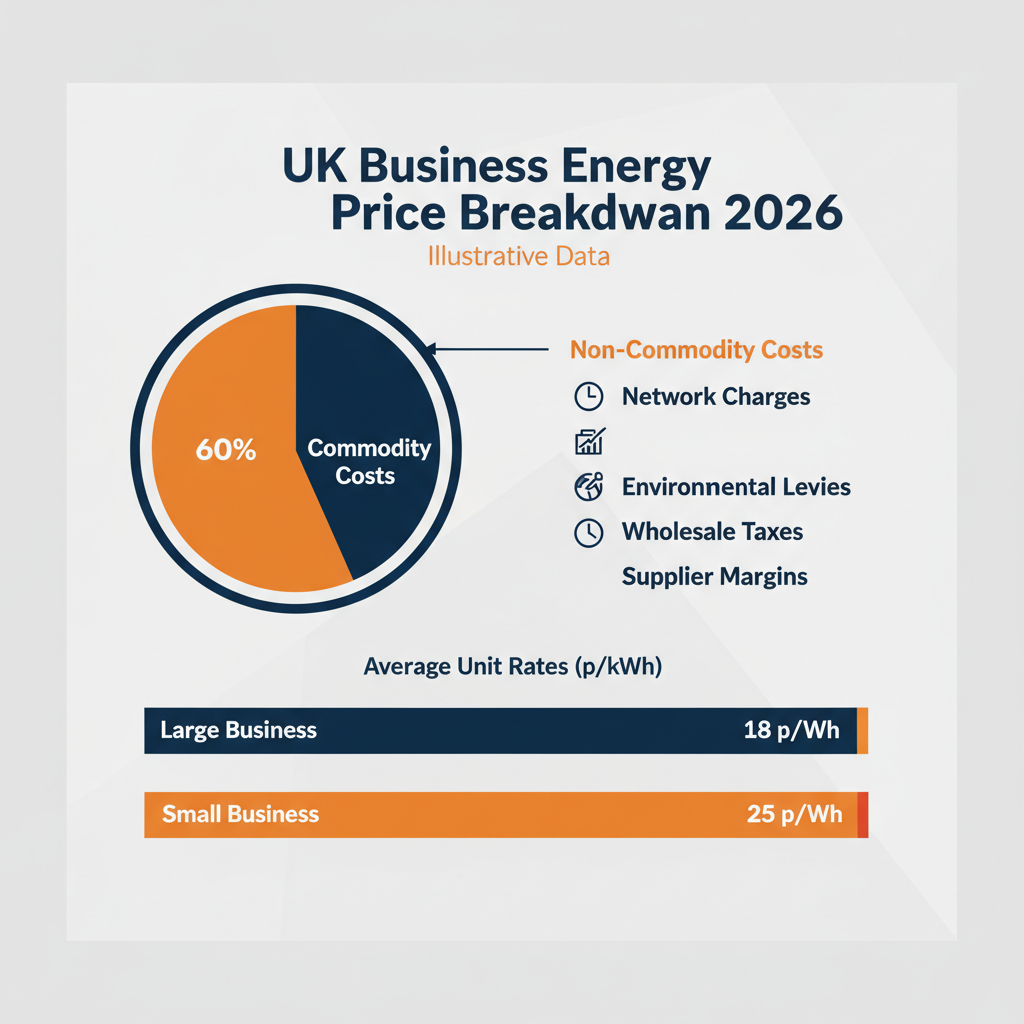
Business energy prices in March 2026 reflect a market still elevated from the 2022 energy crisis but stabilised from the extreme volatility seen in late 2022 and early 2023. Wholesale electricity prices currently sit around £99 to £102 per MWh, down from peaks exceeding £400 per MWh in 2022. Gas prices hover around 131p per therm, significantly below the crisis-era highs of 600p per therm.
Small businesses using approximately 10,000 kWh annually face average costs of £2,866 per year, based on unit rates of 27.8p per kWh and standing charges of 45.6p per day. Medium-sized businesses consuming 25,000 kWh pay around £862 per month, or roughly £10,344 annually, at 26.2p per kWh with standing charges of 143.1p per day.
These figures exclude VAT, which is charged at 20% for most commercial customers. Micro-businesses—those employing fewer than 10 people and consuming less than 100,000 kWh annually—may qualify for 5% VAT on energy.
The market remains influenced by global factors. The ongoing conflict in Iran has disrupted oil and gas flows through the Strait of Hormuz, causing wholesale prices to spike by 43% in 30 days. While prices have recently begun to ease, geopolitical risks remain a key driver of volatility.
Non-commodity costs continue to rise. Transmission Network Use of System (TNUoS) charges are forecast to increase by up to 90% in some regions from April 2026, as National Grid invests in infrastructure upgrades to support renewable energy integration. These costs are passed directly to businesses through higher standing charges and unit rates.
Business electricity comparison requires more than a simple price-per-kWh check. Accurate comparisons account for consumption patterns, contract terms, payment methods, and regional distribution costs.
In March 2026, leading suppliers offer the following indicative rates for small businesses (10,000 kWh annual consumption):
For larger businesses consuming 25,000 kWh:
These rates are illustrative and vary by postcode, meter type, and contract length. Suppliers adjust pricing daily based on wholesale market movements.
When comparing, consider:
E for Energy compares live rates from over 20 suppliers, presenting options ranked by total annual cost, not just unit price. Our service is free, impartial, and designed to save businesses time and money.
Running an effective business energy comparison requires preparation, accuracy, and understanding of contract terms. Follow these steps to ensure you secure the best deal:
Collect the following information:
Accurate consumption data ensures quotes reflect your actual usage, not industry averages.
Manual supplier research is time-consuming and incomplete. Comparison platforms like E for Energy streamline the process. Enter your postcode, consumption, and business details to receive live quotes from multiple suppliers.
Compare total annual cost, not just unit rates. A supplier offering the lowest per-kWh price may have higher standing charges or additional fees.
Fixed-rate tariffs lock in unit prices for 12 to 36 months. They protect against wholesale price increases and simplify budgeting. Most businesses prefer fixed tariffs for stability.
Variable-rate tariffs fluctuate with market conditions. They offer flexibility and no exit fees but expose businesses to price volatility.
Multi-rate tariffs suit businesses with Economy 7/10 or half-hourly meters. Off-peak rates after 6pm and on weekends can significantly reduce costs for operations running outside standard hours.
Review contracts for:
Non-commodity costs now account for nearly 60% of a typical business electricity bill. These include:
These charges are set by regulators and passed through by suppliers. While you cannot avoid them, understanding their impact ensures accurate cost comparisons.
E for Energy explains every cost component in plain language. We highlight total contract cost, break down non-commodity charges, and identify the best-value tariff for your business.
E for Energy is a UK-based business energy consultancy specialising in procurement and management of electricity, gas, and water. Positioned as a transparent and expert partner, we focus on helping businesses navigate market complexities to secure sustainable and cost-effective utility contracts.
Our approach is built on three pillars:
We explain every element of your energy contract in clear, accessible language. No jargon, no hidden fees, no surprises. You understand exactly what you are paying for and why.
Our team monitors market trends, regulatory changes, and supplier pricing daily. We identify the optimal time to fix rates, negotiate contract terms, and avoid costly auto-renewals.
We educate businesses on consumption patterns, tariff structures, and energy efficiency strategies. You gain the knowledge to make informed decisions and manage energy costs proactively.
E for Energy works with a panel of trusted suppliers, including major players like British Gas, E.ON Next, and Octopus Energy, alongside specialist providers. We compare live rates tailored to your business size, location, and usage profile.
Our service is free. Suppliers pay us a commission, ensuring impartial advice focused on your best interests, not sales targets.
Since our founding, we have helped hundreds of UK businesses reduce energy costs, improve sustainability, and simplify utility management. Whether you operate a single-site SME or a multi-location enterprise, we deliver results.
Choosing between fixed and variable tariffs is one of the most important decisions in business energy procurement. Each has distinct advantages and risks.
Fixed tariffs lock in unit rates and standing charges for a set period, typically 12 to 36 months. Prices remain constant regardless of wholesale market movements.
Advantages:
Disadvantages:
Fixed tariffs suit businesses prioritising stability and operating on tight budgets. In March 2026, with geopolitical risks and regulatory cost increases on the horizon, fixing a competitive rate offers protection against future volatility.
Variable tariffs fluctuate with wholesale market prices. Rates adjust monthly or quarterly based on supplier costs.
Advantages:
Disadvantages:
Variable tariffs suit larger businesses with financial buffers and risk tolerance. They work best during periods of stable or falling wholesale prices.
Given the current market environment—elevated wholesale prices, rising regulatory costs, and geopolitical uncertainty—most businesses benefit from fixing rates for 12 to 24 months. E for Energy monitors market conditions daily, advising clients on the optimal time to fix or switch.
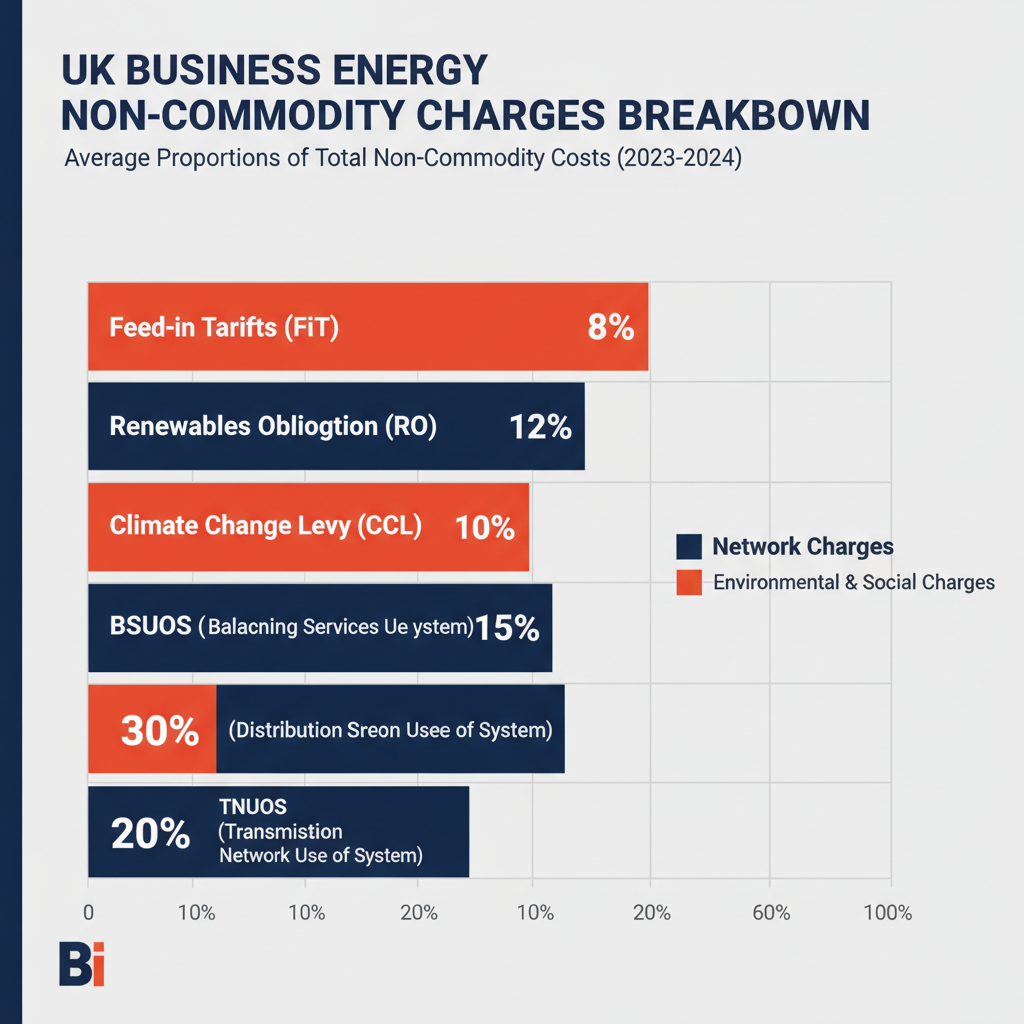
Business energy bills comprise two main components: commodity costs (the electricity or gas itself) and non-commodity costs (charges for infrastructure, regulation, and environmental schemes).
Non-commodity costs now represent nearly 60% of a typical business electricity bill. Understanding these charges is essential for accurate cost comparison.
TNUoS charges fund the high-voltage transmission network operated by National Grid. They cover the cost of transporting electricity from generators to local distribution networks.
Charges vary by region and are forecast to rise by up to 90% in some areas from April 2026 due to infrastructure investment required for renewable energy integration.
DUoS charges fund local distribution networks operated by regional Distribution Network Operators (DNOs). They cover maintenance and upgrades to the low-voltage network delivering electricity to your premises.
Charges depend on your DNO region and consumption profile.
BSUoS charges cover the cost of balancing electricity supply and demand in real time. National Grid manages grid stability by dispatching generators and paying wind farms to curtail output when supply exceeds demand.
In 2025, wind curtailment alone cost over £1 billion, a cost passed to businesses through BSUoS charges.
The Renewables Obligation supports early renewable energy projects. Suppliers must purchase Renewables Obligation Certificates (ROCs) or pay a buyout fee. This cost is passed to consumers.
CCL is an environmental tax designed to encourage energy efficiency. It applies to most UK businesses and is charged per kWh consumed. Current rates are approximately 0.775p per kWh for electricity and 0.568p per kWh for gas.
Businesses can reduce CCL by joining the Climate Change Agreement Scheme if they operate in energy-intensive industries.
CfD schemes support new low-carbon generation by guaranteeing prices for renewable energy projects. The cost is funded through consumer bills.
Standing charges are fixed daily fees covering meter maintenance, network connection, and administrative costs. They apply regardless of consumption.
For small businesses, standing charges range from 45p to 50p per day for electricity and 25p to 35p per day for gas. Larger businesses pay higher standing charges, typically 140p to 150p per day for electricity.
E for Energy breaks down every non-commodity charge in your contract, ensuring you understand total cost and can compare suppliers fairly.
Switching business energy suppliers is straightforward when managed correctly. The process takes 5 to 21 working days and requires no engineer visits or service interruptions.
Review your current contract to identify:
Switching within your renewal window avoids exit fees. If you miss the window, you may roll onto expensive out-of-contract rates, often 20% to 40% higher than fixed tariffs.
Collect:
Accurate data ensures quotes reflect your actual usage.
Use E for Energy’s comparison service to receive live quotes from over 20 suppliers. We rank tariffs by total annual cost, highlighting the best-value options.
Choose a tariff based on:
E for Energy guides you through the decision, explaining trade-offs and highlighting the best option for your business.
Once you select a tariff, E for Energy manages the entire switching process. We:
You receive a switch confirmation email and a final bill from your old supplier. Your new supplier sends a welcome pack and contract details.
Set a calendar reminder for 90 days before your new contract ends. This ensures you can compare rates and switch again if better deals are available.
E for Energy offers contract renewal reminders, market updates, and ongoing support to ensure you never roll onto out-of-contract rates.
Green energy tariffs provide electricity and gas from renewable sources, including wind, solar, hydro, and biomass. They support sustainability goals and reduce carbon footprint.
In March 2026, green tariffs are competitively priced, often costing just 1p to 3p more per kWh than standard tariffs. Some suppliers, including Octopus Energy and E.ON Next, offer 100% renewable electricity as standard.
Suppliers match your consumption with Renewable Energy Guarantees of Origin (REGOs) or Renewable Gas Guarantees of Origin (RGGOs). These certificates prove that an equivalent amount of renewable energy was generated and fed into the grid.
Some suppliers go further, investing directly in UK renewable projects. Ecotricity, for example, generates its own wind and solar power.
Green tariffs offer:
Green tariffs are no longer premium-priced. Many suppliers offer renewable electricity at similar rates to standard contracts. For businesses committed to sustainability, the marginal cost is minimal.
E for Energy helps businesses evaluate green tariffs, comparing costs, renewable credentials, and supplier commitments to ensure genuine environmental impact.
Business energy procurement is complex. Many businesses make costly mistakes that inflate bills and lock them into unfavourable contracts.
Most suppliers automatically renew contracts at higher rates if you do not provide notice within the renewal window. Auto-renewal rates can be 20% to 40% higher than market rates.
Solution: Set calendar reminders 90 days before your contract ends. Compare rates and switch if better deals are available.
The lowest unit rate does not always mean the lowest total cost. Standing charges, exit fees, and non-commodity costs significantly impact annual bills.
Solution: Compare total annual cost, not just per-kWh rates.
Quotes based on estimated usage often underestimate or overestimate costs, leading to budget surprises.
Solution: Provide actual consumption data from recent bills. Use MPAN and MPRN numbers to ensure accuracy.
Long-term contracts with high exit fees lock businesses into unfavourable rates. Short-term contracts require frequent renewal and expose businesses to rate increases.
Solution: Choose contract lengths aligned with your business planning cycle. For most SMEs, 12 to 24-month fixed contracts offer the best balance.
Businesses often delay switching due to perceived complexity. Meanwhile, they pay inflated out-of-contract rates.
Solution: Use a comparison service like E for Energy to simplify the process. Switching takes minutes and requires no technical knowledge.
Many businesses assume green tariffs are expensive. In reality, renewable energy contracts are often price-competitive and support sustainability goals.
Solution: Compare green tariffs alongside standard contracts. E for Energy highlights renewable options at no extra cost.
E for Energy delivers transparent, expert-led business energy consultancy tailored to UK SMEs and large commercial organisations. We simplify procurement, reduce costs, and empower clients to manage utility expenses proactively.
E for Energy prioritises transparency, education, and client empowerment. We explain every cost, highlight savings opportunities, and ensure you understand your contract.
Our panel includes major suppliers like British Gas, E.ON Next, Octopus Energy, SSE, and specialist providers. We negotiate rates on your behalf, securing deals unavailable through direct supplier contact.
We offer free service, funded by supplier commissions. This ensures impartial advice focused on your best interests, not sales targets.
Our clients save an average of £500 to £1,450 annually by switching to optimised contracts. We help businesses:
Identifying the UK cheapest energy supplier in 2026 requires understanding market dynamics, comparing total annual costs, and selecting tariffs aligned with your business needs.
Key points to remember:
Energy procurement is not a one-time task. Regular reviews, proactive switching, and market monitoring ensure you maintain cost-effective contracts year after year.
Who is the cheapest energy supplier for UK businesses in 2026?
The cheapest supplier depends on your consumption, location, and contract preferences. Comparison tools like E for Energy identify the best-value tariff.
How much can businesses save by switching energy suppliers?
Businesses save £500 to £1,450 annually on average by switching from out-of-contract rates to competitive fixed tariffs.
What are non-commodity charges?
Non-commodity charges include TNUoS, DUoS, BSUoS, Renewables Obligation, Climate Change Levy, and Contracts for Difference. They fund infrastructure and regulation.
How long does it take to switch business energy suppliers?
Switching takes 5 to 21 working days. No engineer visits or service interruptions are required.
Are green energy tariffs more expensive?
No. Green tariffs are often price-competitive, costing just 1p to 3p more per kWh, and many suppliers include renewable electricity as standard.